 TurfAI User Guide
What is agentic automation?
From fixed pipelines to AI that decides its own next step.
Traditional automation is a fixed pipeline: you wire step A to step B to step C, and the system runs exactly that path every time. It is predictable, but it cannot adapt — every branch and exception has to be designed up front.
Agentic automation adds a second mode: components that decide what to do next. An AI agent is given a goal and a set of tools, and it reasons in a loop — pick a tool, observe the result, decide again — until the goal is met. TurfAI gives you both modes and lets you mix them on one canvas.
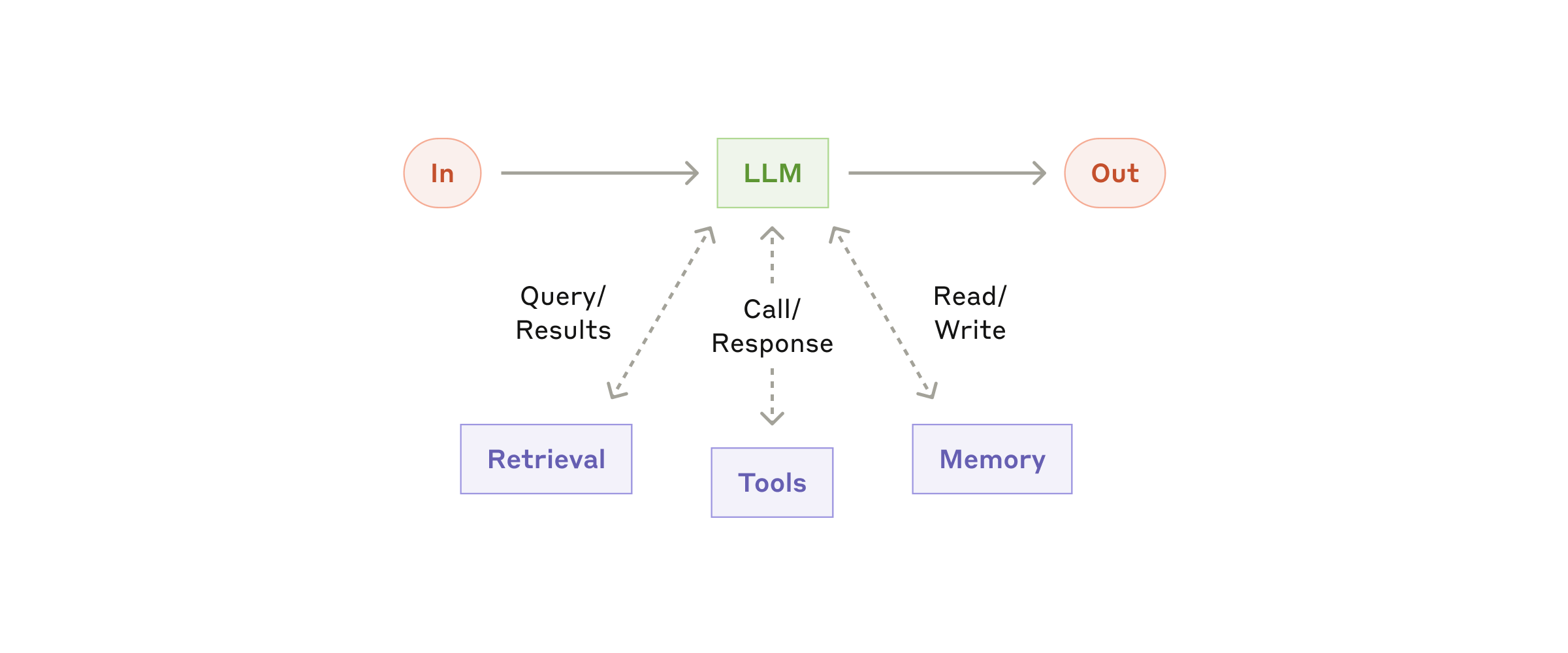
The building block underneath every agent: an LLM augmented with retrieval, tools, and memory.
Source: Anthropic ↗Foundational framing adapted from Anthropic's "Building effective agents".
Deterministic vs. agentic
The deterministic path on the left is the visual workflow — you control the order. The
loop on the right is the ReAct loop inside an agent: Reason → Act → Observe, repeated up
to max_iterations times. You don't draw that loop; the agent runs it for you.
The ReAct loop in detail
Every agent and squad member runs the same loop. This is the single most important mental model in the platform.
Because the agent picks its own tools and order, the same agent handles inputs that a
fixed pipeline could not — a missing field, an unexpected document type, a follow-up question.
The trade-off is determinism: agents are bounded by max_iterations and a temperature
setting, and every run produces a reasoning trace so you can see why it did what it did.
Where this fits in TurfAI
| Layer | What it is | Determinism |
|---|---|---|
| Workflow | A graph of nodes you wire by hand | Fully deterministic |
| Task node | A single typed operation (extract, email, REST…) | Deterministic |
| Agent node | A goal + tools, runs the ReAct loop | Adaptive |
| Squad | Several agents collaborating over a shared blackboard | Adaptive |